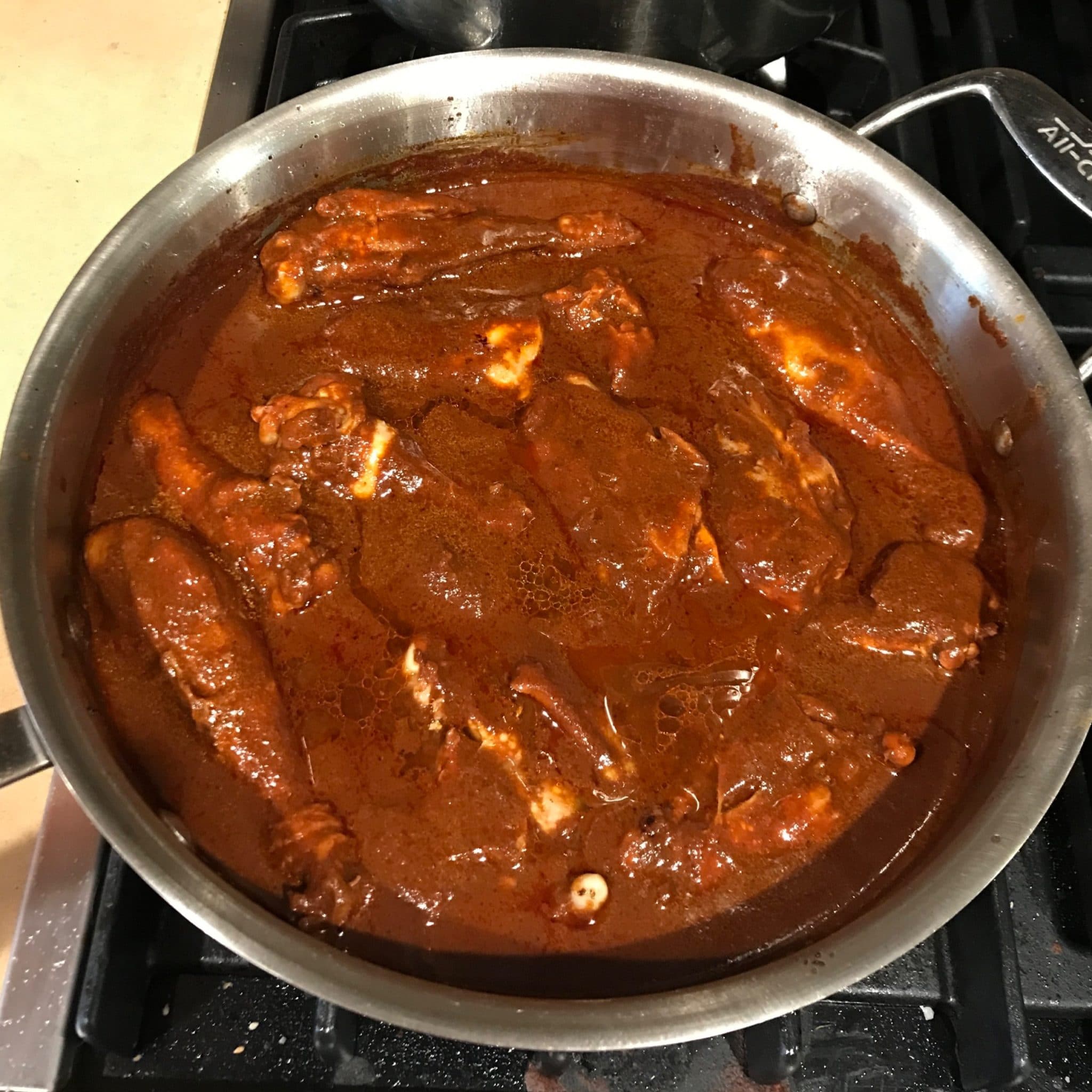
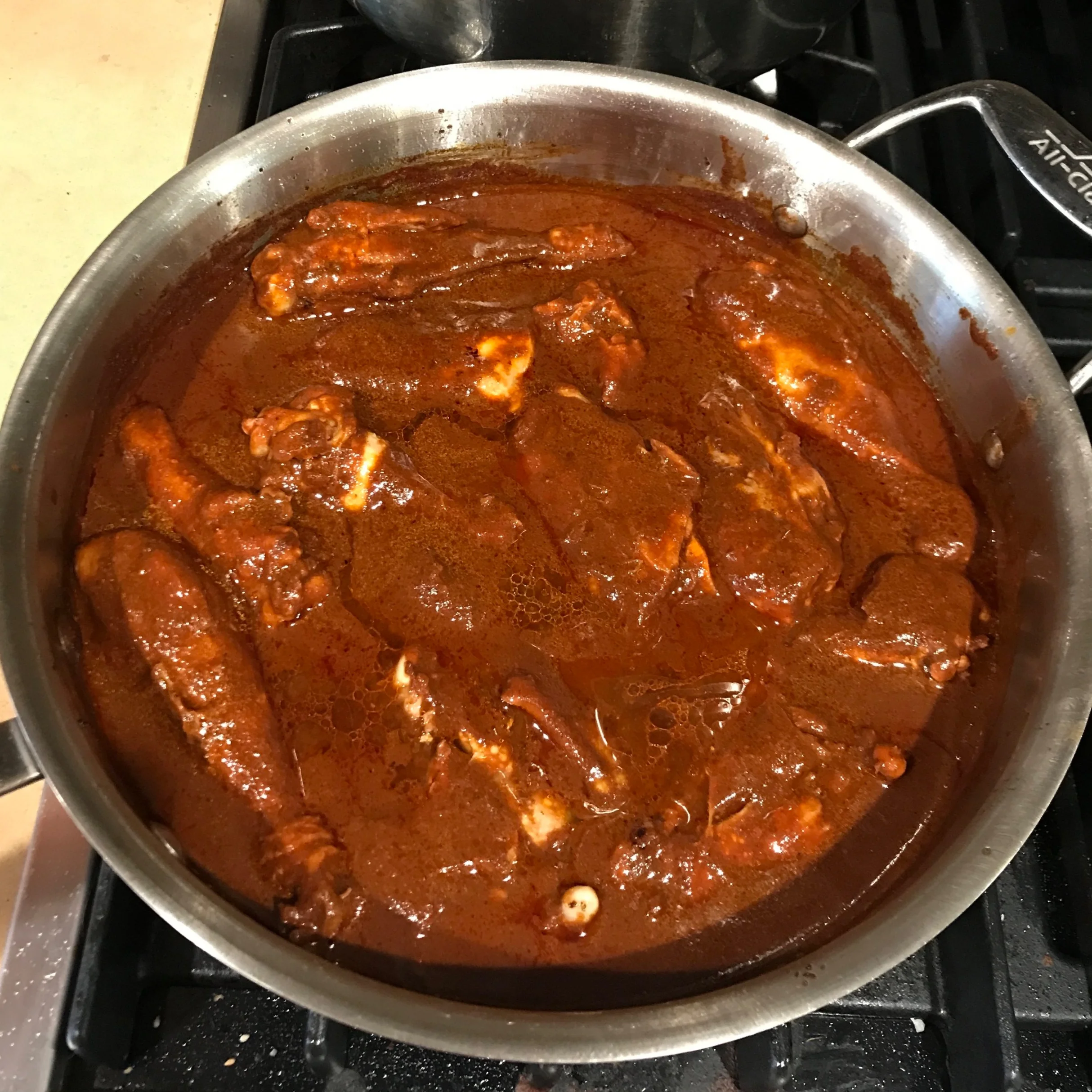
Mole Poblano

Yields: 3 quarts

Time: 4-6 hours

Stage 1: Prepare spice powder

To prepare the chile peppers, step them and shake the seeds into a small bowl. Tear the peppers into pieces and set aside.

12 dried mulato chiles (poblano)

12 dried guajillo chiles

12 dried ancho or pasilla (chile negro) chiles

2 chipotles in adobo, seeded and chopped

Toast in a cast iron skillet over medium heat, stirring occasionally, until lightly brown (~2min). Once toasted, transfer to a mortar or spice grinder.

4 T reserved chile seeds

4 T sesame seeds

Add to the cast iron skillet and toast until fragrant (~1min). Once toasted, add to the toasted seeds.

1 t whole aniseed (or 2 star anise)

1 t black peppercorns

2 t cumin seed

1 t fennel seed

1/2 t whole cloves

2 t coriander seed

5 allspice berries

Add to the toasted nut and spice mixture, grind into a find powder, and transfer to a large bowl.

1 t dried thyme

1/2 t dried marjoram

1 t dried Mexican oregano

3 dried bay leaves, crumbled

1 (1 1/2-inch) stick cinnamon, broken into pieces

1/4 fresh whole nutmeg, grated on a microplane

Stage 2: Prepare the Chile Purée

Heat 2 cups peanut oil or lard in a medium skillet to 350°F over medium-high heat. Working in batches, fry the dried chiles until slightly darkened, about 20-45 seconds per batch. Transfer chiles to a plate lined with paper towels as each batch is finished.

When the frying is done, remove the skillet from the heat, but do not discard the oil. Transfer chiles to a large bowl and cover with boiling water. Let the peppers steep for 30 minutes. 

Then strain the chiles and reserve the soaking liquid.

Prepare a large bowl and fine mesh strainer. Working in 3 batches, place into a blender and purée until as smooth as possible. Strain each batch, using a rubber spatula to push through as much mixture as possible.

1/3 of soaked chiles

1/3 cup soaking liquid

1/4 cup chicken stock 

Stage 3: Fry Ingredients

Return skillet with oil to 350°F over medium-high heat. One at a time, fry each ingredient and transfer to a plate lined with paper towels.

1/2 cup skin-on almonds, fried for ~1 minute

1/2 cup raw shelled peanuts, fried for ~45 seconds

1/3 cup hulled pumpkin seeds (pepitas), fried for ~20 seconds

1/3 cup raisins, fried for ~15 seconds

2 tortillas, preferably stale, fried ~1 minute per side, then broken into small pieces

Transfer fried ingredients to the bowl with the spice mixture.

Stage 4: Prepare Aromatic Base

Set a fine mesh strainer over a small bowl and strain the oil from the skillet. Place 2 T strained oil into an empty skillet (you can use the same one you used to toast spices, if sufficiently large). Heat over medium-high heat until the oil is shimmering.

Add and cook until browned (~10min), stirring occasionally:

1 medium onion, thinly sliced (about 1 cup)

Stir in and cook until fragrant (~1 min):

10 medium cloves garlic, minced (about 10 teaspoons)

Transfer onions and garlic to bowl with spice mixture, leaving as much oil in the pan as possible. Return the skillet to medium-high heat until oil is shimmering.

Add and cook until softened (~10min), stirring occasionally:

2 large tomatillos, husked, rinsed, and quartered

1 large tomato, quartered (or 1 can of diced tomatoes)

Transfer tomatoes and tomatillos to a bowl with spice mixture.

Stage 5: Blend Spice Mixture and Aromatics

Add to the spice mixture bowl:

2.5 cups chicken stock

Working in two batches, purée spice mixture in blender until as smooth as possible. Set a fine mesh strainer over a large bowl and strain spice mixture, using a rubber spatula to push through as much spice mixture as possible. Discard solids and set spice mixture aside.

Step 6: Cook the Sauce

In a large dutch oven or pot, heat 3 tablespoons of reserved strained oil over medium-high heat until shimmering. Add in chile purée and cook, stirring constantly, until mixture has thickened to consistency of tomato paste (~10 minutes). Use a splatter screen so the sauce doesn’t make a mess.

Stir in spice mixture, bring to a boil, then reduce heat to low and simmer, stirring frequently, for 30 minutes. 

Stir in 4 cups chicken stock and 1 cup finely chopped Mexican chocolate. Simmer, partially covered, for 1 hour, stirring occasionally. Season mole with salt (and optionally sugar) to taste. 

Remove from heat, use immediately or transfer to airtight container and store in refrigerator for up to a month. The sauce freezes well.

Notes

  • The chocolate in this recipe will yield a complex sauce that is not identified as chocolate-y. You may add more chocolate to suit your preferences.

  • Less oil works for a shallow fry

  • If the components are too thick to pass through your strainer, try a food mill

  • The sauce should be the consistency of heavy cream. If it’s too thick, thin it with a little broth.

  • A blender works better than a food processor

    • Don’t purée more than half a blender full at a time.

    • Don’t add more liquid than is necessary to keep the mixture moving through the blades; if it’s too thin, the entire mixture won’t be drawn through the blades.

    • Stir the ingredients, blend on low until everything is uniformly chopped, and then blend on high until the purée is smooth when rubbed between your fingers.

    • If the sauce looks coarse or gritty after simmering, re-blend it until smooth.

  • Always strain the mixture

  • Spread the mole making out over three days for maximum flavor (and ease)

    • Before starting mole: make stock, if there is none on hand

    • Day 1 – Prepare ingredients and make the purées

    • Day 2 – sear the purée and combine to complete the sauce

    • Day 3 – cook the meat in the sauce

Pairings

Serve mole over:

  • Turkey (traditional)

  • Chicken

  • Pork

  • Lamb

Leftover mole sauce is excellent for making enchiladas, tamales, brunch eggs, or using as a condiment for rice, eggs, and other foods.

You can garnish mole dishes with:

  • toasted sesame seeds

  • chopped mint

  • chopped cilantro

  • chopped scallions

Variations

Chiles that work well in mole (use 6-12 of each):

  • chipotle meco

  • mulato (poblano)

    • Technically, it distinguishes mole poblano from most other moles

  • ancho

  • pasila (chile negro)

  • chipotle

  • New Mexico

  • California

Easy-to-find pepper mix:

  • 12 dried ancho-pasilla chiles

  • 12 dried guajillo chiles

  • 6 dried california chiles

  • 2 chipotles in adobo, seeded and chopped

Kenji’s pepper mix:

  • 12 dried ancho chiles

  • 12 dried guajillo chiles

  • 6 dried pasilla chiles (also called chile negro)

Other ingredients to try:

  • 1/4 cup Walnuts – toasted

  • 1/4 cup Pecans – toasted

  • 1/4 cup pine nuts – toasted

  • 1/2 small ripe (brown or black) plantain, peeled and cut crosswise into 1/2-inch slices

    • Fry the plantain slices, turning over once, until golden, about 3 minutes.

  • 2 avocado leaves, dried

  • Shallots (instead of onions)

Variants for ingredient preparation:

  • You can toast the ingredients instead of frying

  • Tomato and Tomatillo

    • Broil or roast at 500F in an oven.

    • Core the tomato and cut a small “X” through the skin on the opposite end. Roast the tomato, cored side up, and tomatillos on a foil-lined pan, turning the tomatillos over once halfway through, until their tops and bottoms have blackened and they are a khaki-green color and cooked to the core, 20 to 30 minutes

    • The tomato (without turning) should be cooked until its top is blackened and it’s cooked to the core, 20 to 30 minutes total. 

    • Slip the skin off the tomato.

  • Using tongs, hold the tortilla directly over a burner set to medium, turning it over frequently, until it’s dark, golden brown, and some burned spots appear on both sides. Crumble it into the soaking fried chiles.
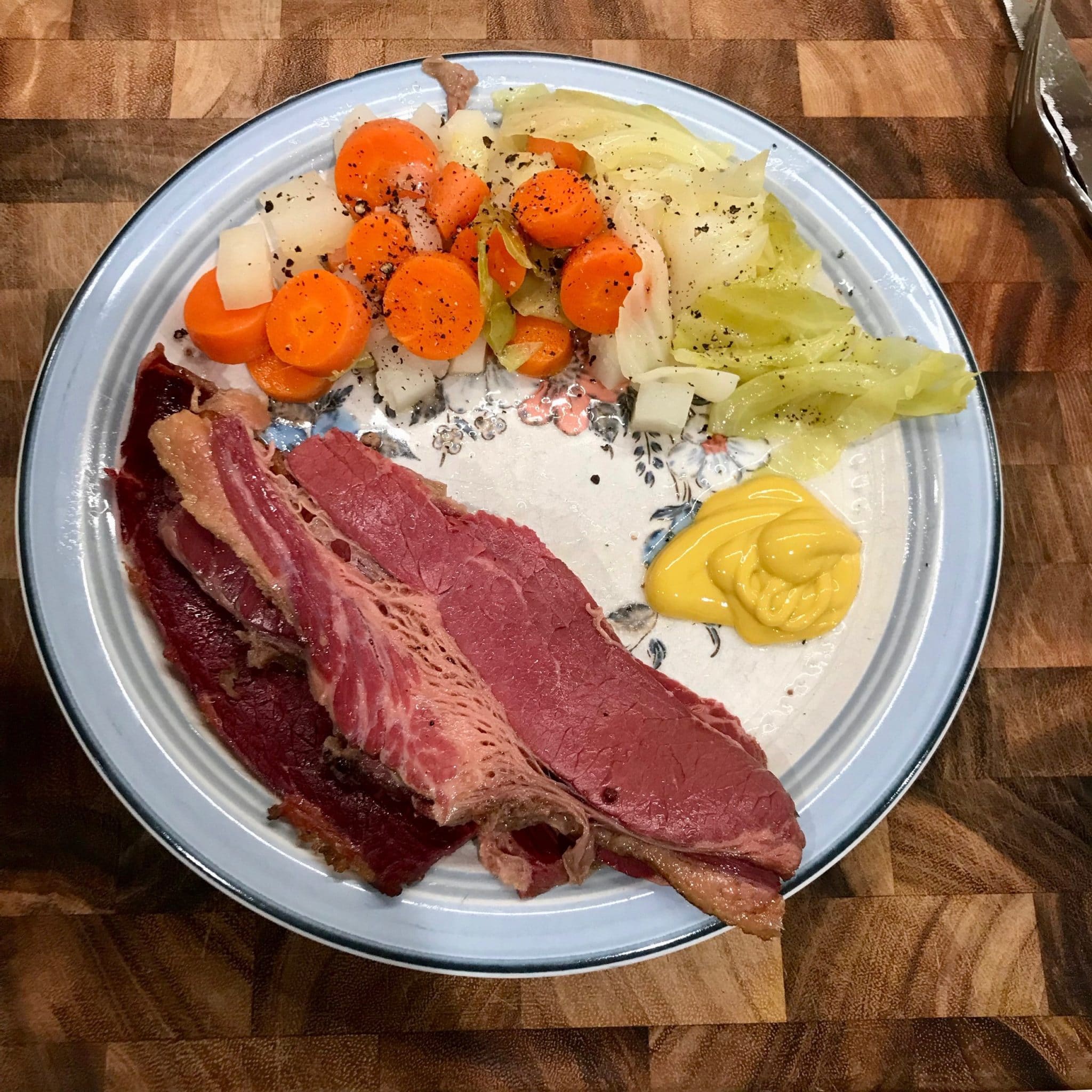


Corned Beef and Cabbage

Traditional Corned Beef and Cabbage

Add the following to a large pot or dutch oven:

Reserved corned beef cooking liquid

2 pounds carrots, peeled and roughly chopped

2 pounds russet potatoes, peeled and roughly diced

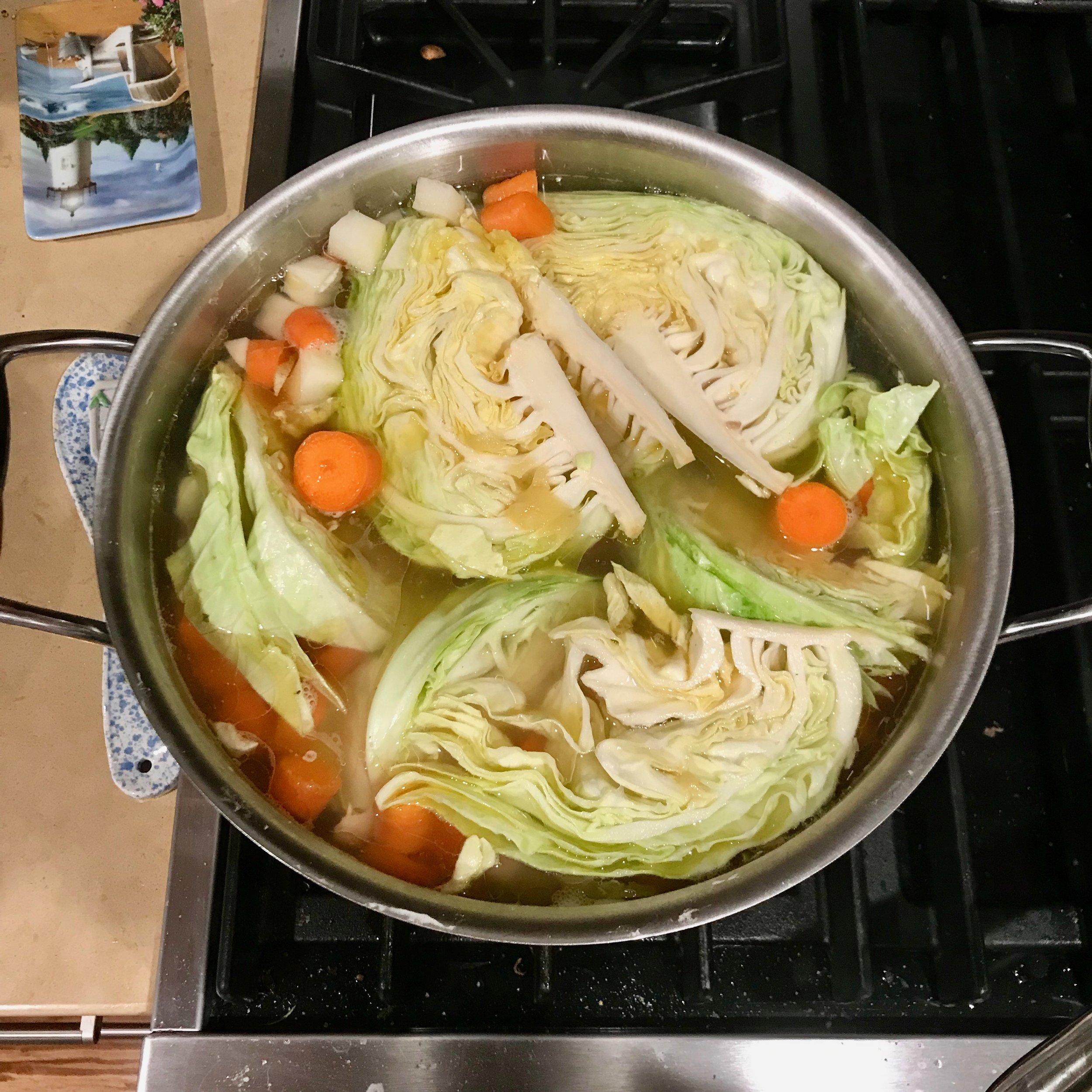
1 whole head white, green, or red cabbage, cut into 6-8 wedges (target 2-3 pounds total)

Water, until vegetables are submerged

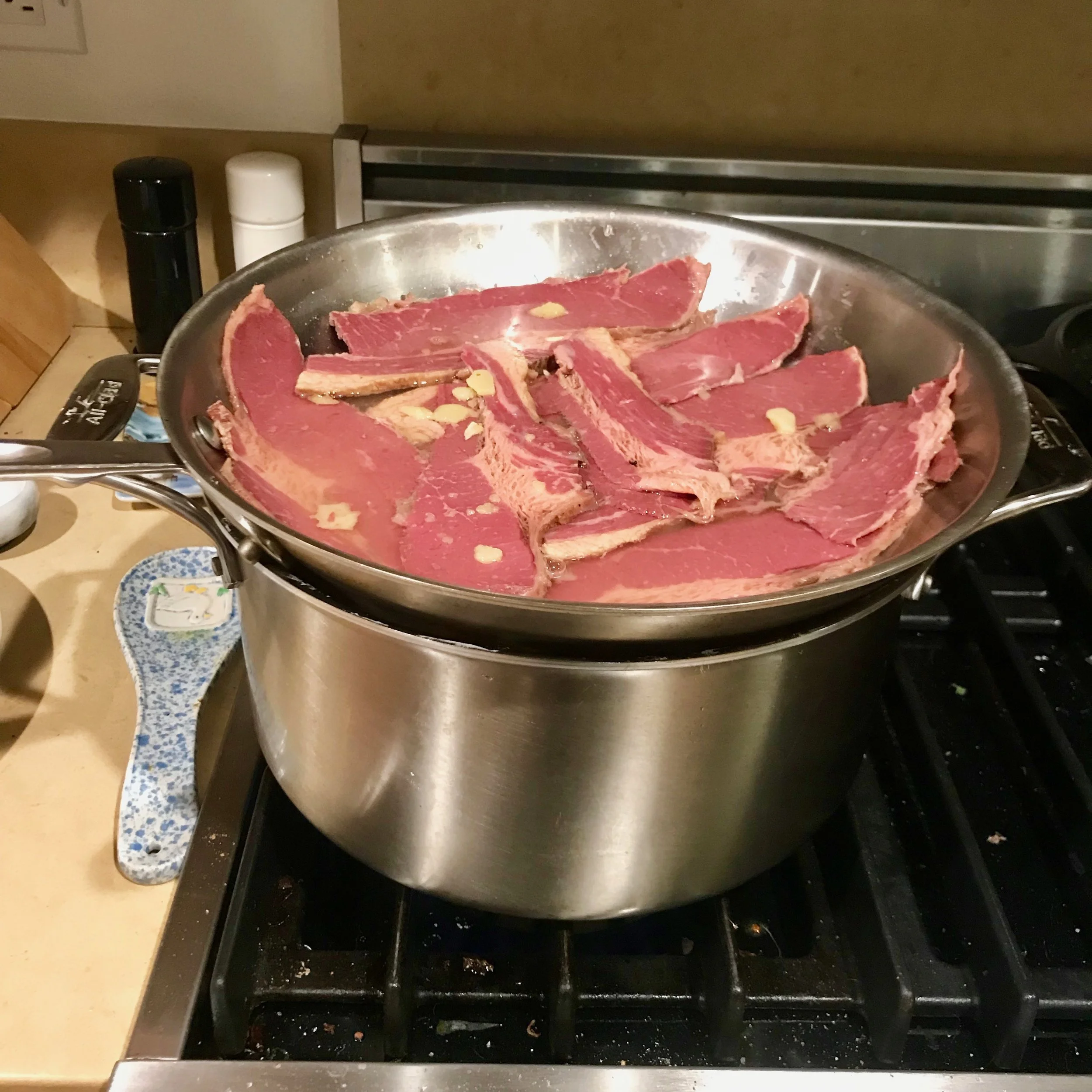
Slice corned beef thinly against the grain and place slices into a skillet which is large enough to sit on top of the cooking pot. Add 1 cup of liquid from the cooking pot to the skillet. Cover the skillet and place it on top of the pot.

Bring the pot to a simmer. Cook until vegetables are completely tender and beef is heated through, about 45 minutes.

Serve immediately with hot mustard.

Fancy Corned Beef and Cabbage

For a fancier corned beef and cabbage, you can use the following strategy:

  • Make a carrot puree

  • Fry or roast potatoes

  • Prepare fancier cabbage:

    • 1 small head + garlic + vinegar + mustard + dill seed + caraway seed + black peppercorns

    • Fill a pot with water, bring to a boil.

    • Halve or wedge the cabbage, sous vide all ingredients at 183F for 90 minutes

  • Fry parsley for garnish

  • To plate:

    • Carrot puree on bottom

    • large mound of cabbage and potato on top

    • Dollops of carrot puree around plate or bowl

    • Add chunks of beef

    • Garnish with parsley

 Veggies in the pot.
Veggies in the pot.
 Reheat corned beef in a pan on top of the pot.
Reheat corned beef in a pan on top of the pot.
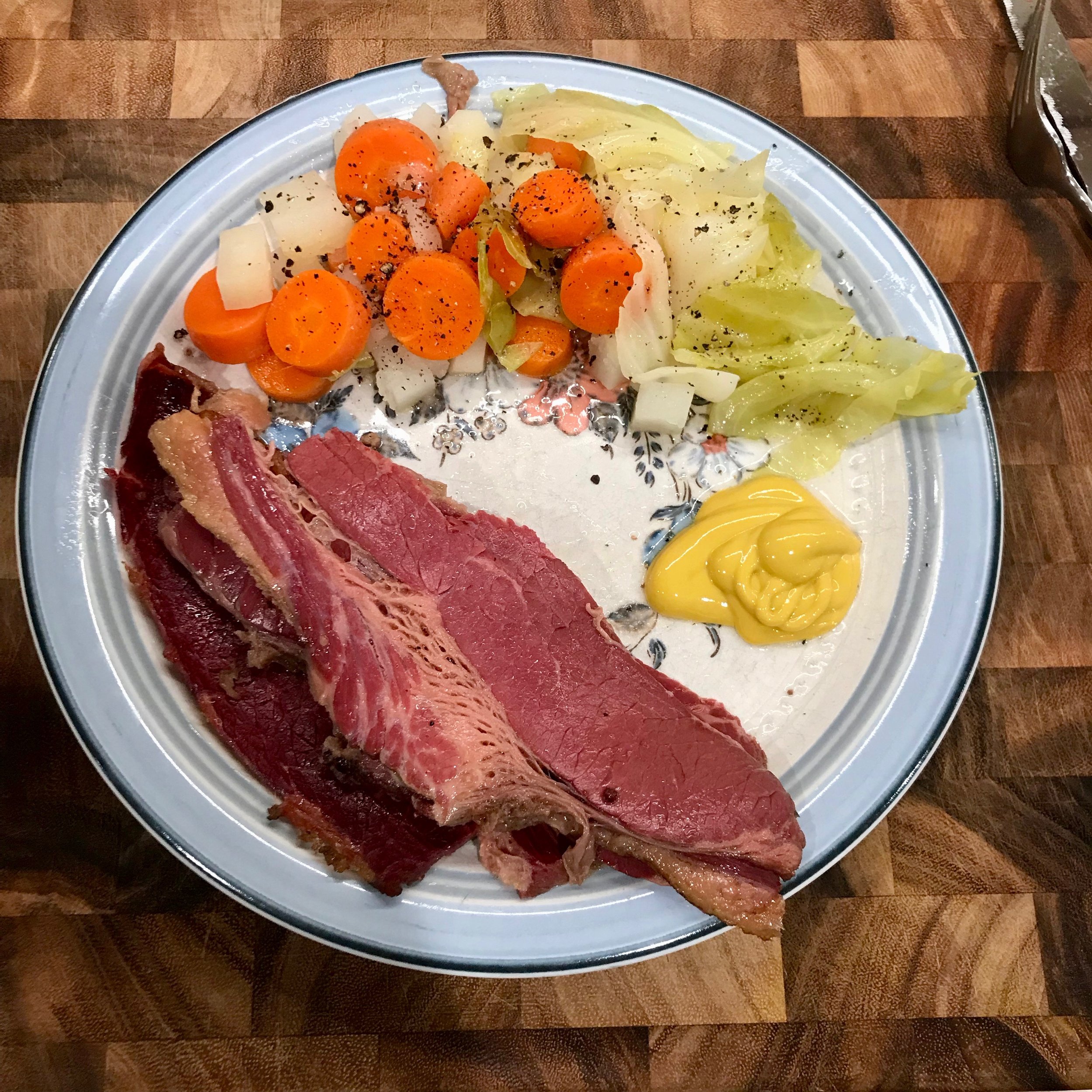
 Plated.
Plated.

Corned Beef

8 days before serving, prepare:

Corned Beef Spice Blend

1 whole flat or point cut beef brisket, trimmed according to your preference (5-8 pounds)

Combine in a small bowl and whisk until homogenous:

~5% salt by brisket weight (100g for 5 pounds)

0.5% pink salt by brisket weight (10g for 5 pounds)

Optional: 30g brown sugar

Rub the salt blend evenly over every surface of the brisket. Sprinkle the spice blend evenly over both sides of the brisket, pressing spices gently into the meat until they stick. Seal the beef in a vacuum sealed bag or a zipper-lock bag with all of the air pressed out of it. Place in coldest part of refrigerator and let rest for 7-10 days, flipping once a day.

1-2 days before serving, remove the beef from the bag and carefully rinse off all spices under cold running water. Pat dry with paper towels. Optionally, massage the brisket with another batch of the Corned Beef Spice Blend.

Sous Vide: Re-seal in a vacuum bag and cook at 180°F until tender, about 10 hours. (See Temperature & Time for alternatives)

Dutch Oven:  Preheat oven to 200°F. Place brisket in large Dutch oven, cover with water by several inches, and bring to a simmer over high heat. Remove from heat, cover with lid slightly ajar, place in oven, and cook until completely tender, about 10 hours. (See Temperature & Time for alternatives)

Once beef is cooked, transfer to an airtight container along with cooking liquid (if cooked sous vide, just store it in its vacuum bag). Let rest at least overnight, and up to 3 days. 

Notes

  • You will have the best results with slicing the corned beef if it’s been cooled first. 

  • Reserve the cooking liquid for corned beef and cabbage.

  • You can corn beef without the nitrites, but it won’t taste the same, last as long, or look the same.

  • The dry-cured beef has deeper flavor penetration and superior texture compared to the brined beef.

Temperature & Time

180°F cooked for around 10 hours is ideal, producing meat that was simultaneously tender and succulent.

  • 180°F: 10 hours

  • 175°F: 15 hours

  • 160°F: 36 hours

  • 154°F: 24 hours

  • 140°F: 48 hours

If you want your beef flakier, cook it at a higher temperature for a shorter time. Prefer it more dense and moist? Try a lower temperature for a longer time. 

With regards to moisture loss, at 160°F, about 30% of the brisket’s has gone out the window. Bring it up to 190°F, and we’re looking at 48% moisture loss. All the way up to 205°F, the temperature at which most people cook their beef (simmered on stove), and we’re at a whopping 53% moisture loss!

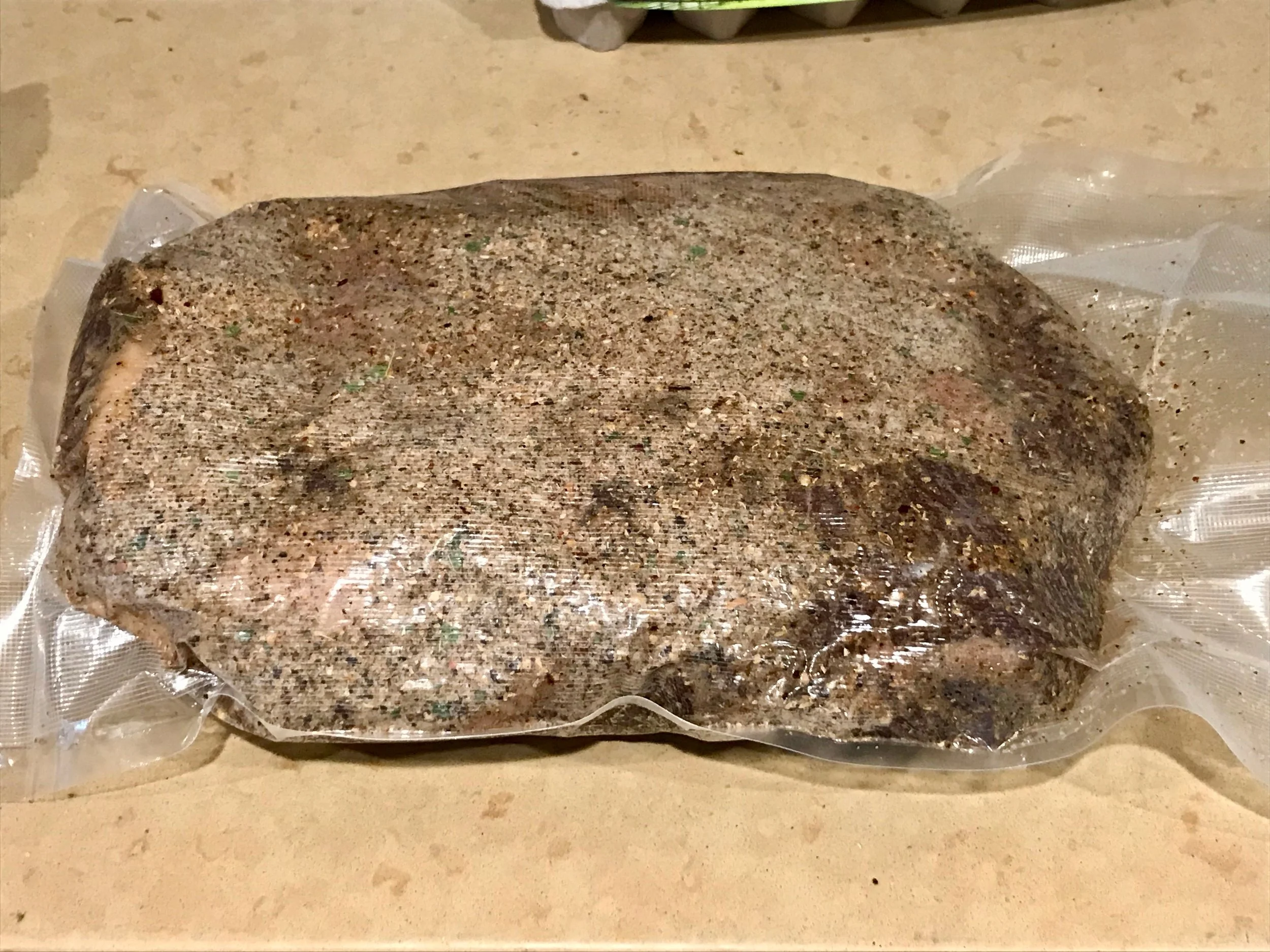
 Brisket ready for dry brining..
Brisket ready for dry brining..
 Reheating sliced corned beef
Reheating sliced corned beef

Corned Beef Spice Blend

This spice blend is used in the Corned Beef recipe.

Coarsely grind in a spice grinder or mortar & pestle:

  • 4 T coriander
  • 2 T black peppercorn
  • 2 T yellow mustard seed
  • 1 T allspice berry
  • 6 whole cloves
  • 2 T ground ginger
  • 6 bay leaves, roughly torn
  • 1 star anise
  • 1 T chili flakes

Notes

  • The spices can be changed to whatever you like

  • The main flavoring constituents of corned beef are largely derived from those used for pastrami: mustard, black pepper, coriander seed, allspice, and a bit of clove.

  • Fennel seeds work nicely

Roasted Bone Marrow

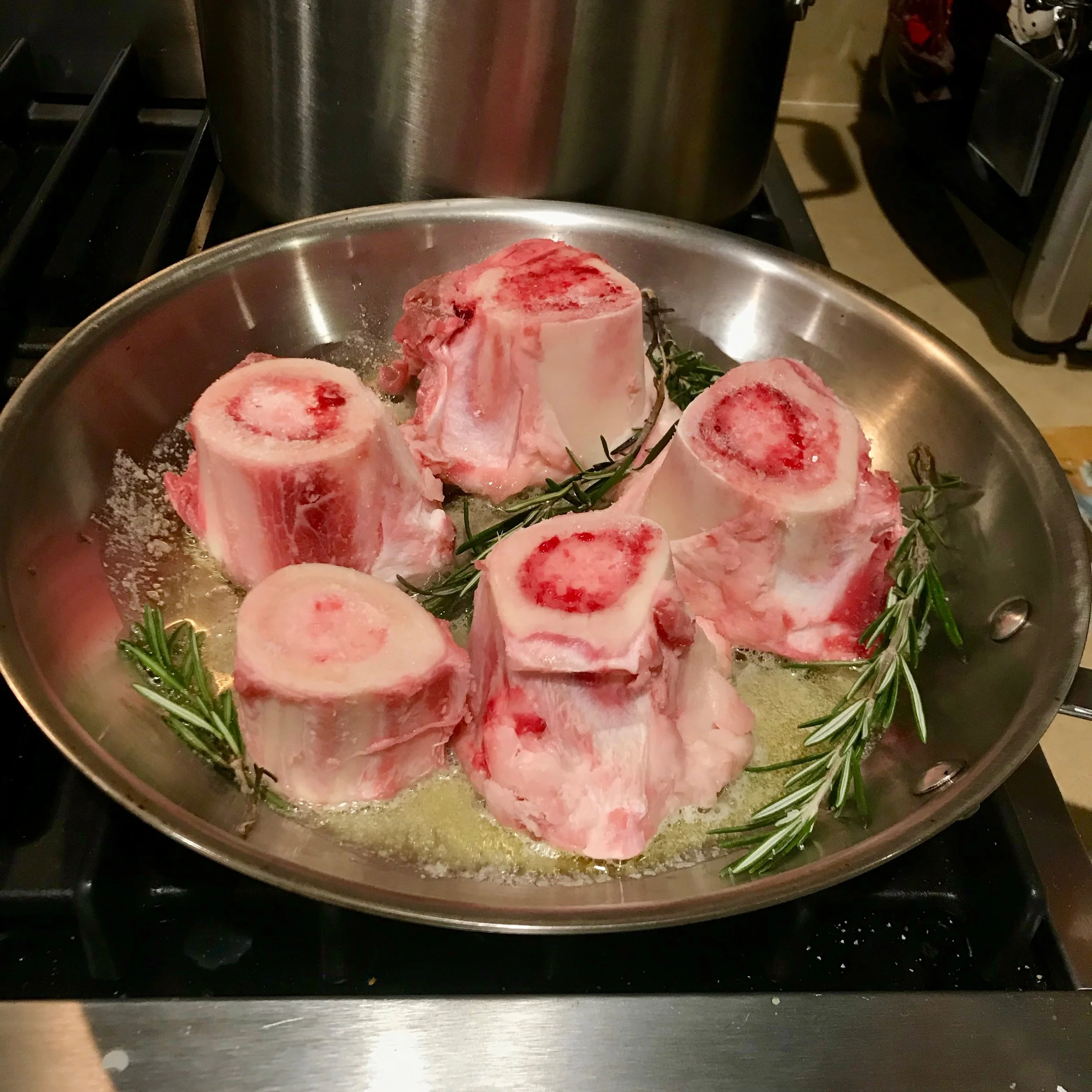
If you would like to remove the blood from the bone marrow, soak in salt water or cover with salt overnight.

Prior to cooking, rinse the bone marrow and pat dry. Salt the bone marrow liberally.

Preheat the oven to 400F. 

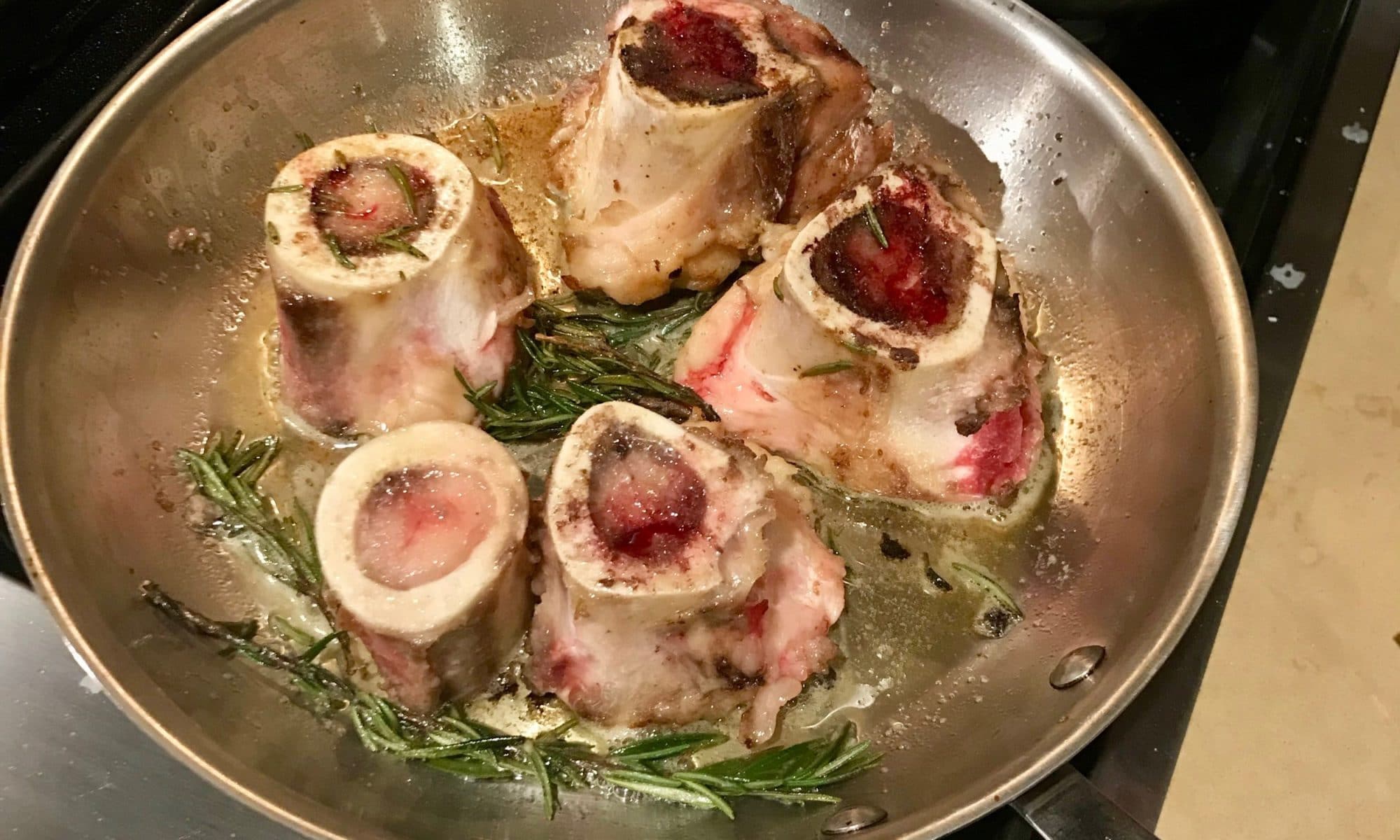
Brown the bones on the stove in butter over medium-low heat. Add thyme or rosemary to the pan to season the meat. Optionally, add smashed garlic cloves to the pan. Once the bone marrow is browned on both sides, baste the bone marrow with the pan butter and transfer the pan to the oven. Cook in the oven for 15-20 minutes.  The bone marrow is done when is bubbly and knife-tender all the way through. Reserve the bone marrow butter remaining in the pan for another use, such as cooking eggs.

Serving Options

  • Garnish with chopped parsley

  • Contrast it with acidic and refreshing flavors or accent its fattiness with something even richer

  • Pair with a small, sharp salad salad

    • Parsley tossed in olive oil, lemon, and capers

    • Substitute watercress or arugula for the parsley

    • Use thinly sliced radishes

  • Bone marrow butter

    • Let marrow bones cool to touch, then scoop out marrow. 

    • Add marrow, raw butter, sea salt, rosemary and parsley to a food processor. Blend until incorporated.

  • Onion, shallot, or garlic confit

  • Onion, shallot, or garlic marmalade

  • Anchovy butter

  • Glaze before roasting with miso, mirin, and soy sauce

  • Smothered and roasted with blue cheese (pair with shallot confit)

 I skipped the soaking step, so there is blood in my marrow.
I skipped the soaking step, so there is blood in my marrow.

Roast Lamb Shoulder

Prepare the spice blend:

3 T smoked paprika
4 T coriander seeds, crushed
2 T cumin seeds, crushed
8 garlic cloves, roughly chopped
(Optional: 2T onion powder)
Salt + Black pepper

Lay out a large double layer of foil and place on top:

1 whole bone-in lamb shoulder (~3 kg)

Score the fat side of the lamb with a very sharp knife. Ensure your cuts do not reach into the meat.

Pour over the meat:

50mL olive oil

Rub the prepared seasoning over the lamb and massage into the meat, then drizzle with:

50mL red wine vinegar

Wrap the foil over the lamb shoulder to completely cover it. Refrigerate the lamb shoulder for 5-24 hours.

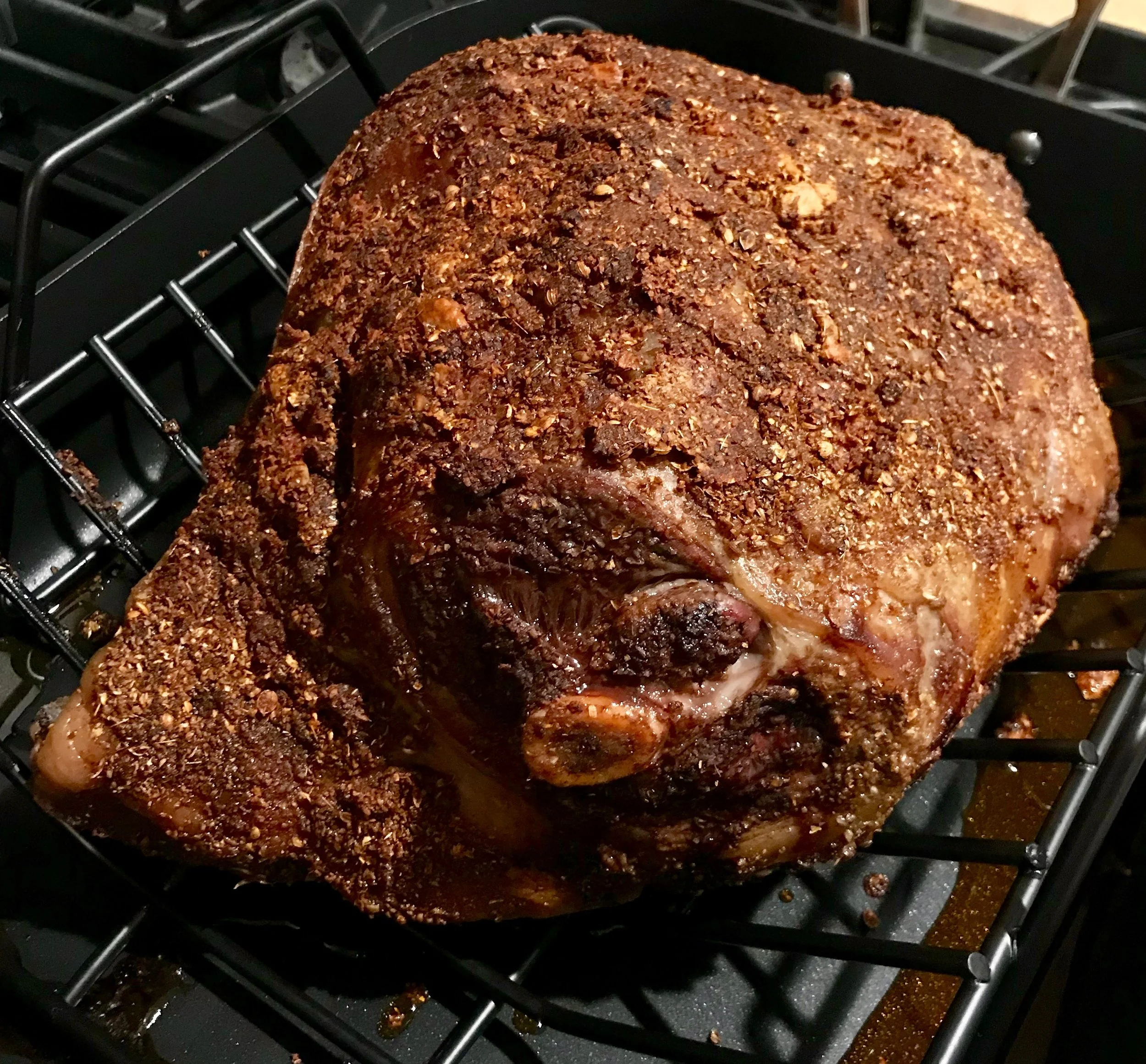
Preheat your oven to 250F. Place the lamb, wrapped in foil, on a roasting pan and insert into the oven. After 3 hours, remove the foil and baste the meat with juices. Cook another 1-2 hours to brown/caramelize the lamb exterior. The lamb is done when you can easily pull the flesh away from the bone. If the meat is still firm, continue to check on it in 30 minute increments. When the lamb is done, remove from the oven and let rest for at least 30 minutes.

While the lamb is resting, whisk together the dressing ingredients:

100mL buttermilk
20mL white wine vinegar
1/2 bunch fresh coriander, chopped
S+P, to taste

To serve, remove the bone and serve the shoulder whole at the table, with the dressing. Alternatively, you can carve the shoulder and serve on a platter.

Notes

Serves 6-8

North African Moorish-style spices are used for this lamb. This recipe benefits from an overnight marinade.

You can make this lamb in the oven or on a barbecue.

Uses for Remaining Meat:

  • Lamb Pasanda Curry with Dal

  • Pulled Lamb Shoulder w/ pickled fennel and cabbage

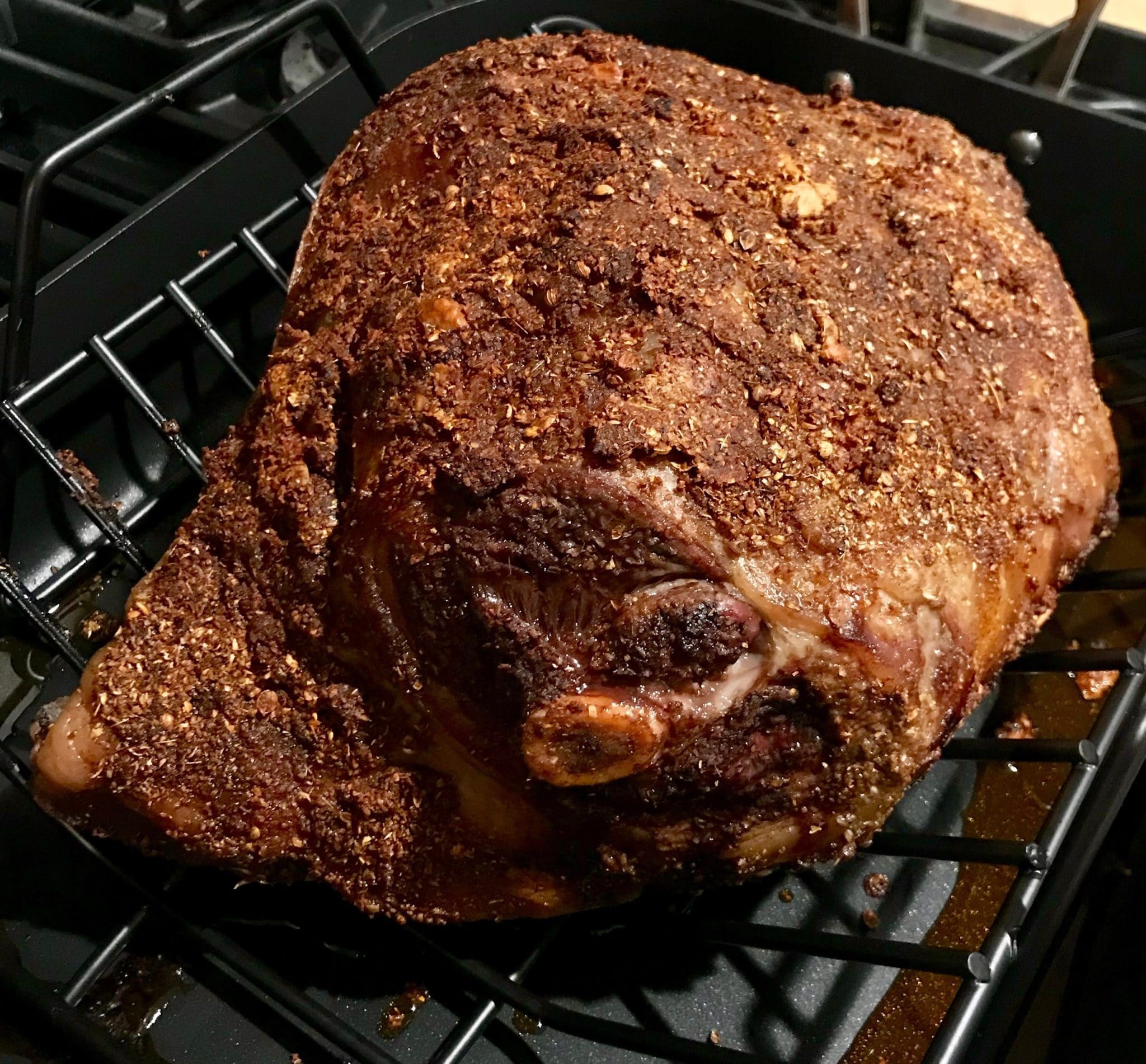
 Lamb shoulder at the 3 hour mark
Lamb shoulder at the 3 hour mark

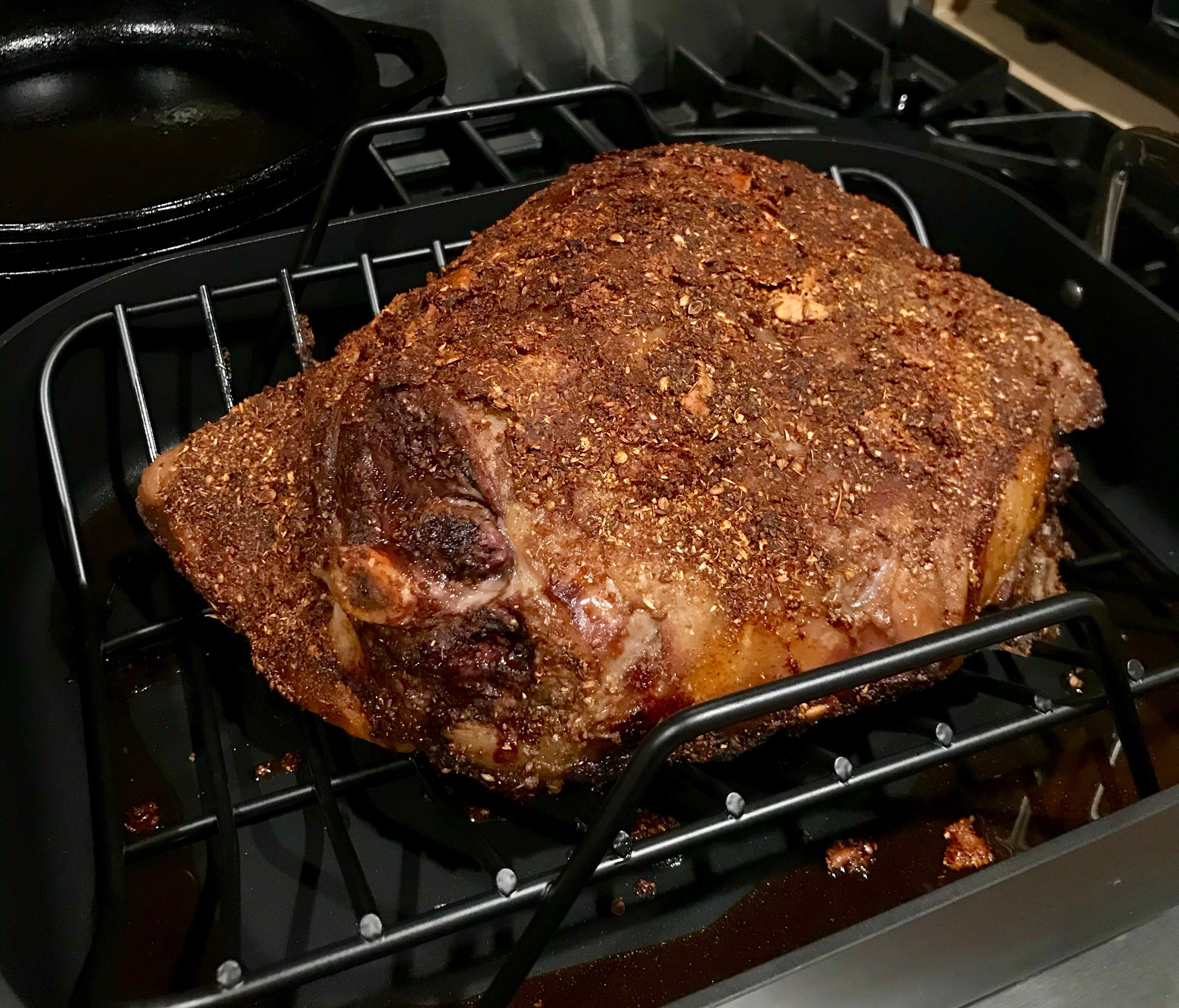
 Finished Lamb Shoulder
Finished Lamb Shoulder

Roasted Herbed Leg of Lamb

This is a great recipe for cooking a whole leg of lamb low-and-slow. The recipe uses the delicious herb rub for meat.

One Day Before Cooking

One day before cooking, pull out for preparation:

1 (6-7 pound) bone-in lamb leg, with the aitch bone removed (ask your butcher to remove it)

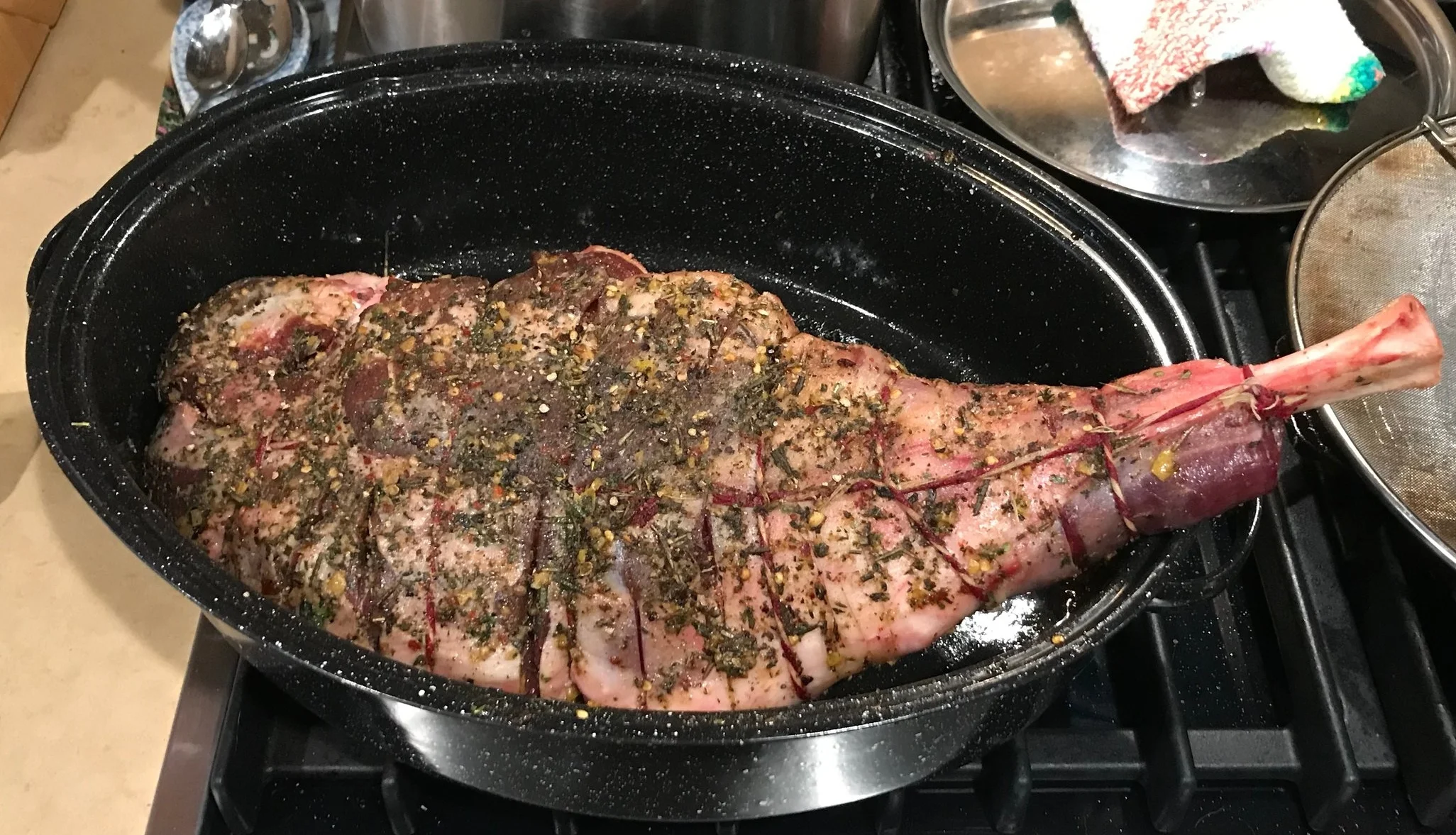
Using a very sharp knife, small small cuts across the surface of both sides of lamb every 1/2 to 3/4″. The cuts should be about 1″ long by 1/2″ deep. These slits will help the marinade soak in and allow the fat to crisp up during cooking. Place the lamb on a rack in a large roasting pan.

Make the full amount of the herb rub. Scrape the paste into a small bowl and set aside.

Pour over lamb and massage in to infuse the meat:

1/3 cup red wine

Run the lamb all over with:

1/4 cup salt

1 T freshly ground black pepper

Work the seasoning in with your fingers, rubbing it thoroughly into the meat. Finally, apply the reserved herb rub all over the lamb, evenly coating it with a thin layer.

Refrigerate the lamb leg, uncovered, for 24 hours.

Cooking the Lamb

The following day, remove the lamb from the refrigerator and let it come to room temp, about 4 hours.

Preheat the oven to 275F. Roast the lamb, uncovered, for 1 hour, until the internal temperature is about 90F when a thermometer is inserted at several points in the thickest area of the leg. Be sure to test all the way into the deepest and largest part of the muscle. Because the leg is such a large cut and of varying shape, it is a good idea to check its internal temp in several of the thickest places. Avoid the bone with the thermometer.

Remove the lamb from the oven and turn the temp to 325. When the oven has reached temp, cook the lamb for another 20-40 minutes, until the internal temp is around 112 at the narrowest part of the leg and no more than 130F at the thickest part of the leg for medium-rare. As before, check the temp in several places. Loosely tent the roasting pan with aluminum foil and let rest for a minimum of 45 minutes and up to 2 hours. The meat can rest in the rack of the roasting pan.

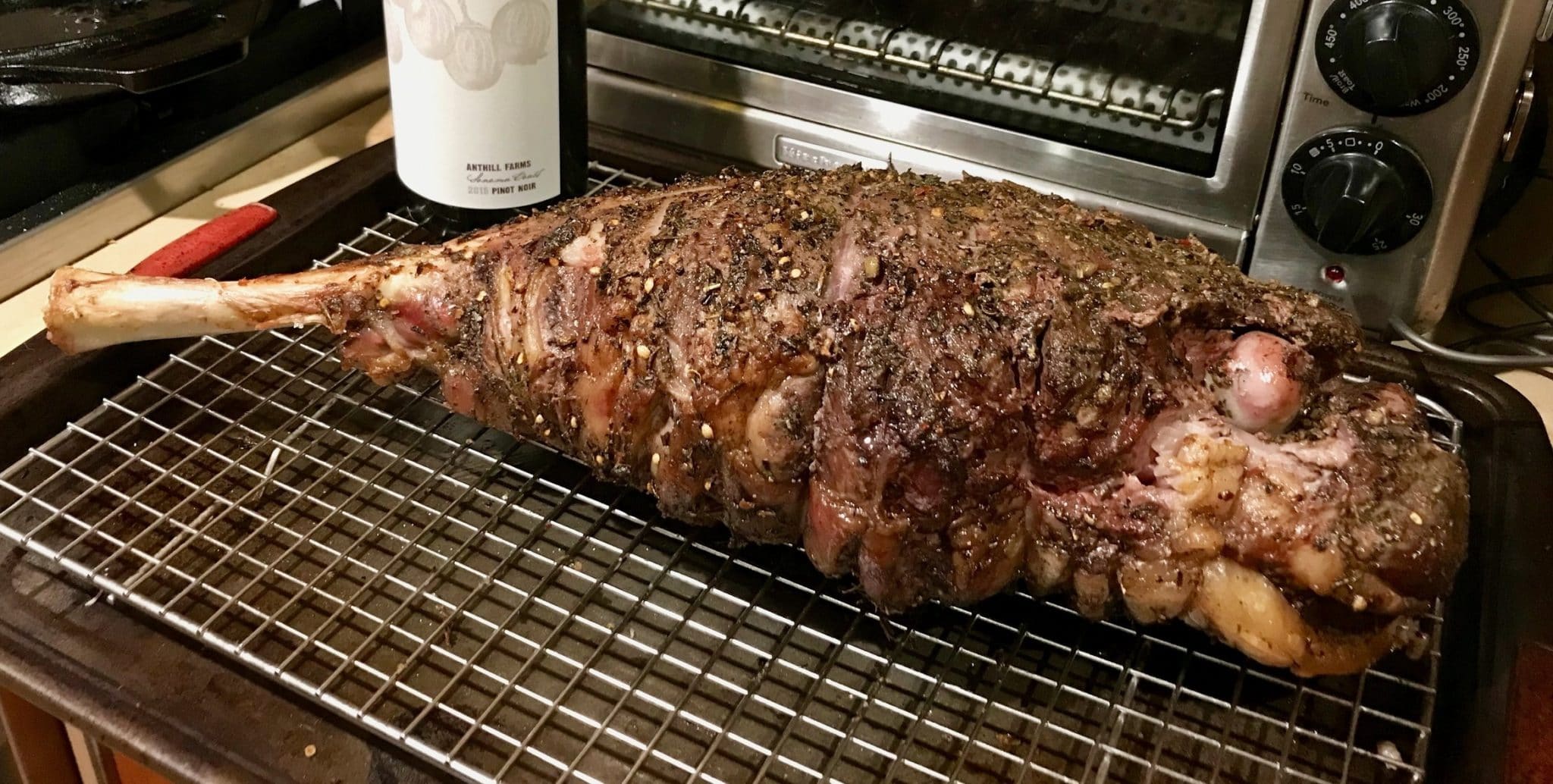
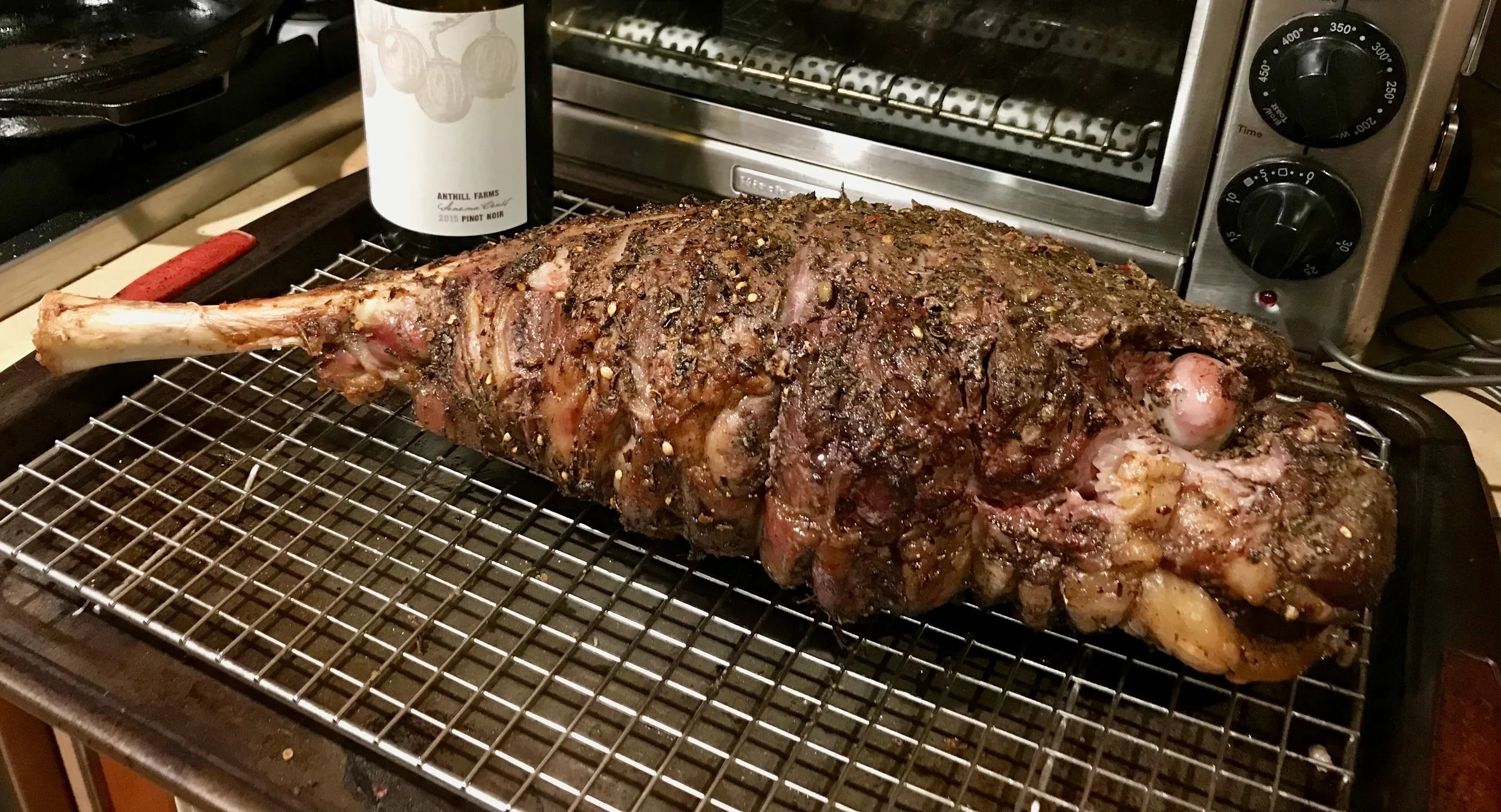
About 20 minutes before serving, preheat the oven to 400F. Put the lamb, uncovered, back into the oven and heat until a gorgeous deep brown color, about 15 minutes. To carve the leg, slide your knife as close to the bone as possible and cut a large peace of meat off the bone. Slice the meat across the grain into individual pieces.

Serve the lamb with fresh rosemary sprigs on a platter family-style so guests can choose the slices they like best.

Notes

This dish can easily replace ham or turkey on a holiday table.

Serves 8, generously

Source

Recipe adapted from Taste & Technique: Recipes to Elevate Your Home Cooking by Naomi Pomeroy.

A Delicious Herb Rub for Meat

To make the herb rub, combine the following in a food processor and blend until evenly combined:

3 Tbsp minced garlic

1/4 cup loosely packed rosemary leaves

1/4 cup loosely packed thyme leaves

6 fresh or 12 dried bay leaves, crushed

Peel of 1 lemon, removed in strips and finely minced

2 tsp fennel pollen

1/2 tsp red chile flakes

1 whole nutmeg, finely grated on a microplane

With the blender running, stream in to make a paste:

1/2 cup EVOO

Scrape the paste into a small bowl and set aside.

Pairing

This rub works especially well on pork shoulder or lamb.

Source

Recipe adapted from Taste & Technique: Recipes to Elevate Your Home Cooking by Naomi Pomeroy.

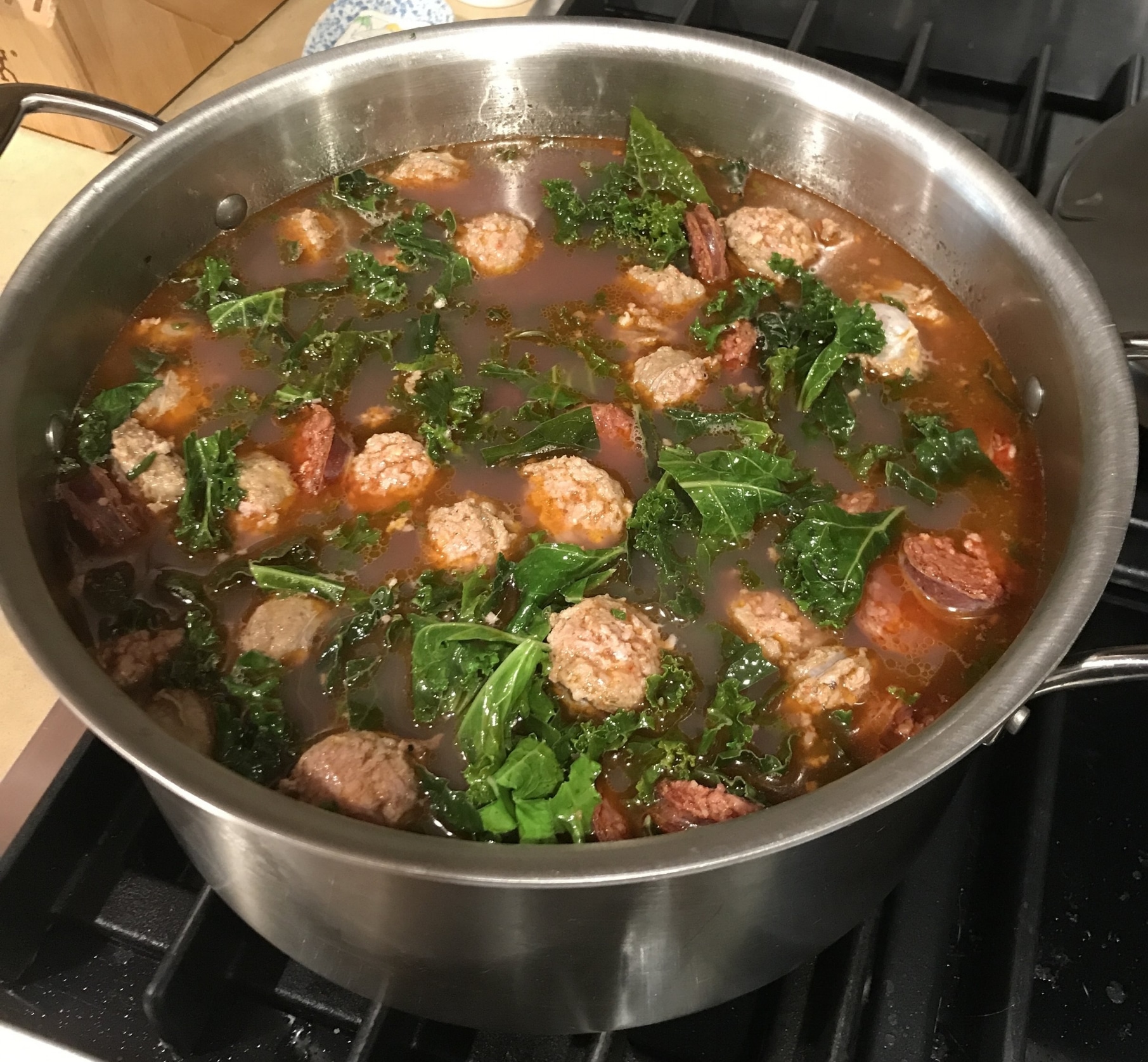
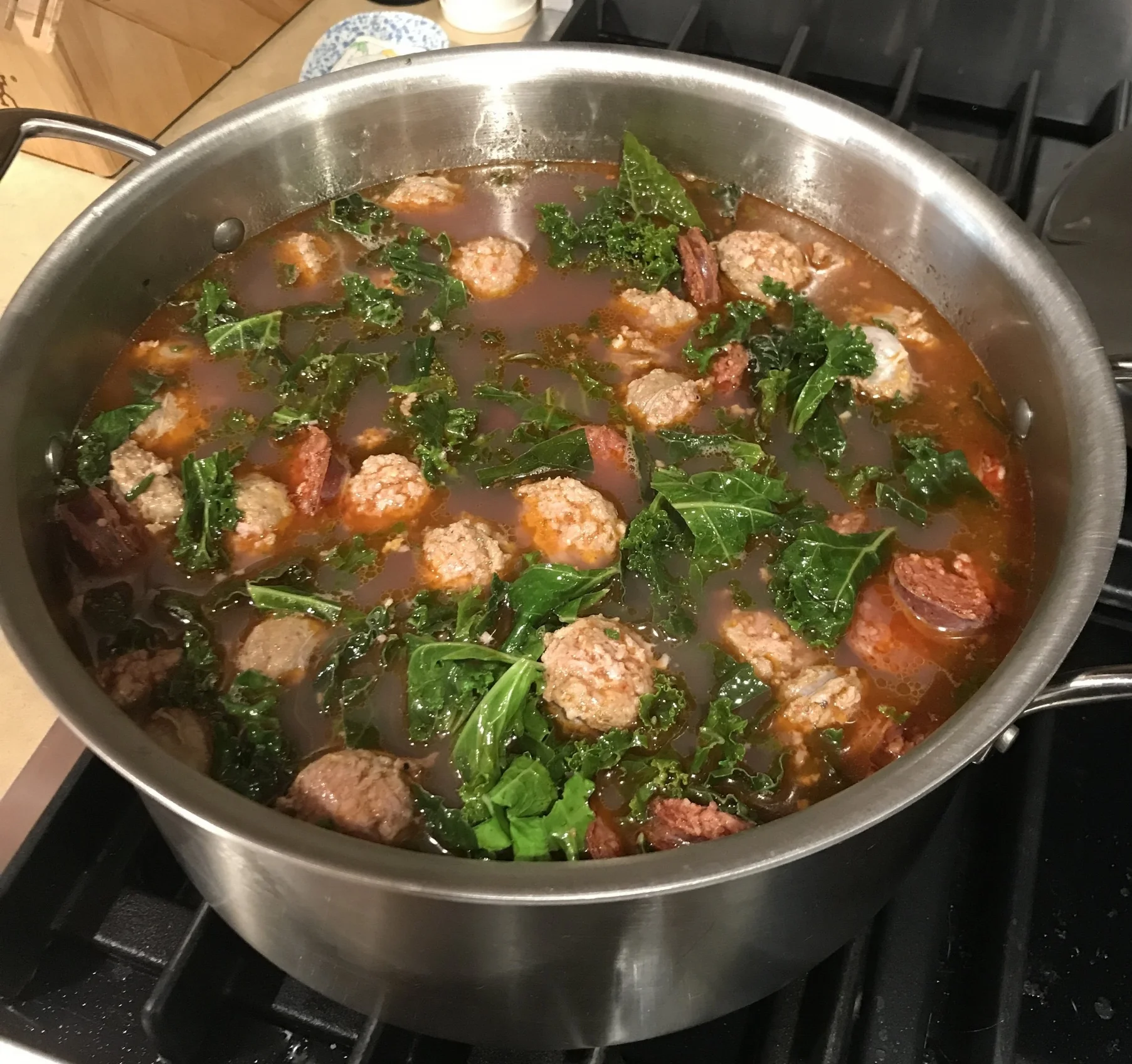
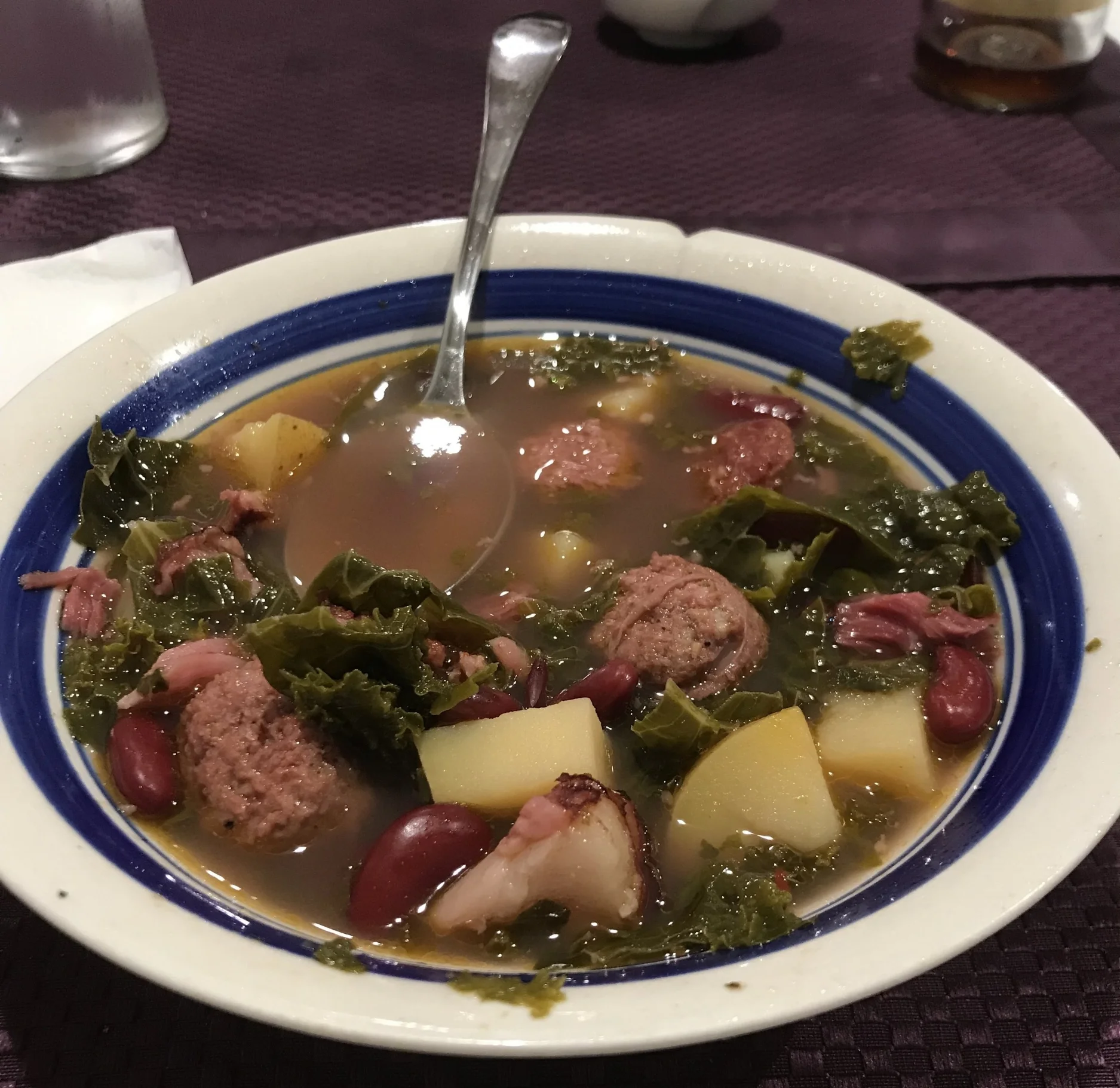
Kale and Sausage Soup

The day before you make this dish, soak in cold water:

1.5-2.5 cups dried beans (red beans and navy beans are good in this recipe)

In a clean stockpot, combine the soaked beans (drained of their soaking liquid) with:

1 large ham hock or comparable soup bone, cut into pieces to allow the marrow to escape
3-4 quarts stock
1 quart water (or more if you do not have sufficient stock)

Bring to a boil, then reduce to a simmer, using a slotted spoon or ladle to skim off and discard any scum that rises to the surface. After 1 hour of simmering, add:

0.5 pound dried chorizo sausage, cut into 1/4″ slices
1 pound linguiça (or other sausage, cooked or uncooked), cut into 1/4″ slices
2 bunches curly kale, center stem removed and discarded, leaves washed and coarsely chopped

Simmer for another hour, then add:

4-5 medium waxy potatoes, peeled and cut into large dice
Red pepper flakes to taste
1-2 T sherry vinegar
S+P to taste

Simmer for at least another hour, adding more stock or water as needed to keep all the ingredients submerged. The longer the soup simmers, the better the flavor; try to simmer the soup for a minimum of five hours. 

Before serving, remove the meat from the ham hock and shred it into the soup. Scoop out any marrow left in the bone.

Serves 8-10

This recipe is adapted from Anthony Bourdain’s Appetites: “Portuguese Kale and Sausage Soup”